EBOOK UMUM KESEHATAN
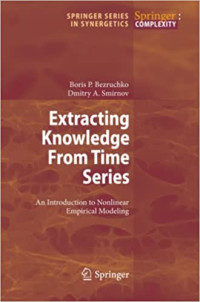
Extracting Knowledge From Time Series: An Introduction to Nonlinear Empirical Modeling
Mathematical modelling is ubiquitous. Almost every book in exact science touches on mathematical models of a certain class of phenomena, on more or less speci?c approaches to construction and investigation of models, on their applications, etc. As many textbooks with similar titles, Part I of our book is devoted to general qu- tions of modelling. Part II re?ects our professional interests as physicists who spent much time to investigations in the ?eld of non-linear dynamics and mathematical modelling from discrete sequences of experimental measurements (time series). The latter direction of research is known for a long time as “system identi?cation” in the framework of mathematical statistics and automatic control theory. It has its roots in the problem of approximating experimental data points on a plane with a smooth curve. Currently, researchers aim at the description of complex behaviour (irregular, chaotic, non-stationary and noise-corrupted signals which are typical of real-world objects and phenomena) with relatively simple non-linear differential or difference model equations rather than with cumbersome explicit functions of time. In the second half of the twentieth century, it has become clear that such equations of a s- ?ciently low order can exhibit non-trivial solutions that promise suf?ciently simple modelling of complex processes; according to the concepts of non-linear dynamics, chaotic regimes can be demonstrated already by a third-order non-linear ordinary differential equation, while complex behaviour in a linear model can be induced either by random in?uence (noise) or by a very high order of equations.
Ketersediaan
Tidak ada salinan data
Informasi Detail
- Judul Seri
-
Extracting Knowledge From Time Series
- No. Panggil
-
-
- Penerbit
- United States of America : Springer Publishing Company, LLC., 2010
- Deskripsi Fisik
-
416 hlm.; ebook.
- Bahasa
-
English
- ISBN/ISSN
-
978-3642264825
- Klasifikasi
-
NONE
- Tipe Isi
-
-
- Tipe Media
-
-
- Tipe Pembawa
-
-
- Edisi
-
-
- Subjek
- Info Detail Spesifik
-
-
- Pernyataan Tanggungjawab
-
Boris P. Bezruchko
Versi lain/terkait
Tidak tersedia versi lain
Lampiran Berkas
Komentar
Anda harus masuk sebelum memberikan komentar
 Karya Umum
  Filsafat
  Agama
Agama  Ilmu-ilmu Sosial
  Bahasa
  Ilmu-ilmu Murni
  Ilmu-ilmu Terapan
  Kesenian, Hiburan, dan Olahraga
  Kesusastraan
  Geografi dan Sejarah